Press Releases

Gemma Robinson
L-Acoustics L2 Delivers for Radiohead's Record-Breaking Return to Arenas
Britannia Row and FOH engineer Simon Hodge deploy lightweight L Series system for in-the-round production, achieving consistent 360-degree coverage with unprecedented efficiency
LONDON, UK - February 2026 -- When Radiohead announced their first tour in seven years, the Oxford quintet made a bold choice: rather than the traditional end-stage setup, they would perform in the round on a small circular stage at the centre of each arena. The decision reflected the band's commitment to creating a more intimate connection with audiences despite playing some of the largest venues in Europe.
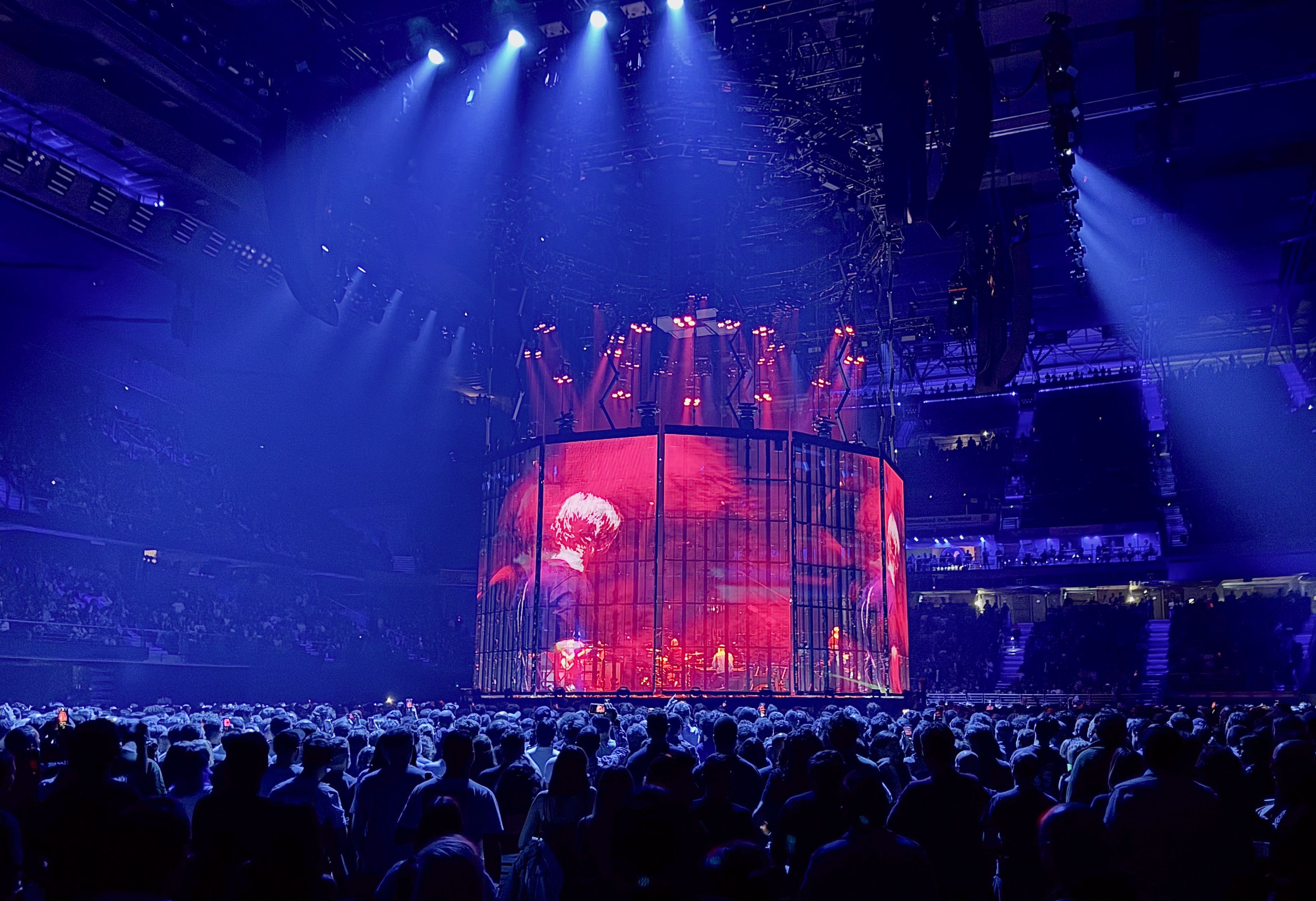
The results exceeded expectations. At London's O2 Arena in late November, where Radiohead performed four sold-out shows, they broke the venue's attendance record night after night. The final show drew 22,355 people—a new high-water mark for the iconic venue and a testament to both the band's enduring appeal and the production team's ability to deliver exceptional sound to every seat.
To meet the demanding requirements of the in-the-round configuration—including a dynamic 360-degree LED screen floating above the stage that could transform from a decagon to a star shape while spinning—L-Acoustics Certified Partner Britannia Row Productions and FOH engineer Simon Hodge deployed a comprehensive L-Acoustics L Series system. Hodge, who has worked with Thom Yorke and Jonny Greenwood since 2020 on their project The Smile, was among the first engineers to take L2 on tour. His experience with the system during The Smile's 2024 tour convinced him it was the right choice for Radiohead's more ambitious production.
"I was struck by the directionality of L2 and how controlled the low mid is due to the continuous baffle," Hodge explains. "But equally important was efficiency. It's a relatively small number of lightweight boxes, which makes it incredibly efficient in terms of production resources and easy to load in and out."
This efficiency was critical. The arrays were installed in the very centre of every venue, requiring careful rigging considerations. The tight timelines—with cable bridges running from FOH to the centre of the arena and PA load-in typically starting at 6:00 AM—demanded a system that could be deployed quickly and reliably.
"The creative designs for this tour started over a year ago and involved considerable planning," Hodge continues. "The geometry for audio coverage was particularly demanding. We needed a system that could deliver consistent coverage while minimizing interference with the visual production and accommodating audiences on all sides of the stage at various elevations."
Precision Design Solves Complex Coverage Challenges
Working with production designer Josh Loyd, Hodge's final design consisted of eight hangs of three L2 and one L2D positioned at the corners of a square containing the circular stage, providing consistent 360-degree coverage. A total of 12 A10 Wide provided front-fill coverage. The low-frequency system involved 32 KS28 subwoofers flown centrally on a custom-made cart that handled all cable management, amplified controllers, and rigging, supplemented by 24 ground-stacked KS21 subwoofers. The system was powered by 37 LA7.16 and 13 LA12X amplified controller. All L2 arrays were deployed in supercardioid mode, with Panflex horizontal coverage angles carefully adjusted to avoid exciting reflective surfaces in each room. For larger venues, small Kara II delays brought back high frequency in the top rows.
The extended vertical coverage of L2D proved essential for reaching front rows without sight-line interference from the dynamic LED installation. "Thanks to the excellent off-axis response of L2, we achieved great coverage everywhere," Hodge notes. The centralized KS28 deployment created coherent low-end response throughout each venue while keeping the stage remarkably quiet—a critical factor for the band's performance.
L-Acoustics Soundvision software was vital during the design phase. "With the latest updates modeling the TM array, dispersion became extremely easy and fast," says Hodge. "We were able to evaluate the need for delays, correctly aim arrays based on seating geometry, and align front-fills and delays beforehand—saving precious time on-site."
Loyd's thoughtful design placed the amplified controller carts behind the arrays and in front of the cable bridges, allowing the audio team to be largely independent from other departments and streamlining daily operations. The team used Milan-AVB as the main audio protocol, with its seamless integration with both LA7.16 and LA12X simplifying programming and patching. A P1 was used for backup and to tune the system through the M1 platform.
Exceptional Results Across Historic Shows
"L2 is game-changing in how quick it is to deploy and how even the coverage is once you’ve correctly modelled it in Soundvision," Hodge concludes. "Despite all the challenges involved in an in-the-round gig, we were able to achieve stunning sound all the way to the very last row.
"These historic shows were as successful as they were because of the sound. Both the artist and monitor engineer were astonished by how quiet the stage was, and everyone involved in the production was remarkably impressed by how well the system performed," Hodges explains.
The tour garnered widespread critical acclaim. NME gave the opening London show five stars, praising "a visceral energy, a tasteful spectacle, all delivered with a generosity of spirit." The review concluded: "For a band once embarrassed by the notion of 'arena rock,' nobody does it better."
Media assets available at: https://medialibrary.l-acoustics.com/bCGwNd20h